Could we use this model to cut short the long way to rural digital transformation?
Could Kirkpatrick’s model and Roger’s DOI theory be used to identify early adopters of digital technologies?
Technology Synopsis: The history and evolution of the cellular phone technology
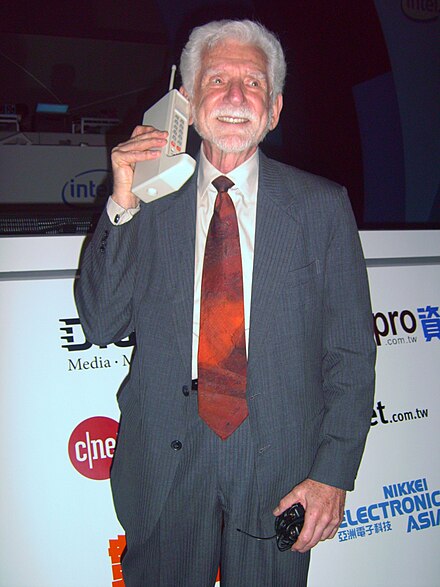
In 1973, Motorola released the DynaTAC, a non-commercial product, a prototype that was used to demonstrate the feasibility of cellular phone technology. It was developed by a team of engineers led by Martin Cooper, who made the first publicized handheld mobile phone call on April 3, 1973, using a DynaTAC prototype. The call was made to his rival, Joel Engel, who was the head of research at Bell Labs.
DynaTAC took 10 hours to charge, the power that lasted for 20 minutes of talk time. It had a small display that showed the phone number and the signal strength. Its memory could only store 30 phone numbers, and it weighed 1.2 kgs. It was a ground-breaking invention for Motorola and Martin Cooper himself, while it was no better than land-line and car-mounted mobile phones to the public. It had regulatory hurdles, technical difficulties, high costs, and low consumer demand.
Motorola announced the development of the Dyna-Tac in April 1973, saying that it expected to have it fully operational within three years. It took another 10 years for Motorola to launch the first commercially available cell phone, the Motorola DynaTAC 8000X, in 1983 at retail price of $3,995 (about $11,300 in 2022). Today, one of the latest cellular phones, iPhone 14 plus, weighs 203 grams, 15% of DynaTAC mass. It takes 1 hour to recharge from 0% and that can last for 20 hours of online video streaming.
Today, our eyes are always on cell phones. According to the International Telecommunications Union (ITU), there were 7.9 billion mobile subscriptions in 2020 and more than 5.5 billion (66%) of the 7.8 billion world population owned a smartphone.
Could we use this model to cut short the long way to rural digital transformation?
We all resist to technology or innovations, when inefficient and disruptive
In their early days, cellphones, electricity, cars, cameras, TVs and many other most reliable technologies today were ridiculed, condemned and rejected when they could not satisfy the users or demotivate with outlandish features than the existing means of achieving the same goals or value. Today, they are responsible for our modern, progressive and fulfilling life.
Basically, technology does not create new life processes, desires or satisfaction, they only either change the way we achieve them or ability to do the impossible and unmaginable. Technology or innovations in their early days are often ridiculous and are undesirable because most of us hate to be disrupted the way we do things, we have limited imagination of how and what things can be done and do not want to stress out thinking, trying out new things.
Internet and most of its constituent or contemporary technologies (including non-digital) are in their “early stages” or in incompatible form to many people, and worse in the rural areas. Most of the content and digital tools or technologies are in English language, require some familiarity with computers and are newly developed that they are still in their early stages.
In rural areas, access to internet is intermittent and less efficient due to limited network coverage, power supply and personal incomes to cover cost of data. Van Dijk (2005) categorised these into four types of access barriers to communication technology. These include; motivational access, physical access, digital skills and usage access barriers.
Underutilised opportunities
The Internet and its related digital technologies are now relieving us from most of our tasks which we used to do in a hard way and even those we couldn’t. Despite bringing some social problems along, the overall effect is evidently beneficial for human society.
Internet and digital technologies constitute continuously adding thousands of different technologies and those technologies consist of continuously adding millions of unique topics and functions (content). Most of these offer more efficient and effective ways of knowing what we need to know, doing what we find hard to do or accessing what we cannot afford to. However, a thin line of barriers always prevent many of us from leveraging these technologies or content.
This has consequently widened further the existing inequalities around access to social services and economic opportunities. This necessitated the creation of 3rdWorld Xplorations. The idea is not to donate devices, but to find possible ways of how underprivileged rural communities can leverage emerging technology to equally access the available social services and economic opportunities.
Testing the use of Kirkpatrick’s model and Roger’s DOI theory to identify early adopters of digital technology
From the broad idea of 3rdWorld Xplorations, we are attempting to design and build a semi-online platform to help rural communities leverage internet and digital tools by supporting with awareness, access and use, and simultaneously generate data that can help those orchestrating rural digital transformation to understand the usability, outcomes and impact of each internet content and digital tool.
We believe that this data can be used to design cost-effective permanent solutions and/or upscaling approaches, from efficient digital tools to efficient practical technologies such as clean energy, improved farming methods, educational content and healthy services that can be used by everyone and result in better living standards for all.
To successfully identify early adopters of digital technologies and content based on EM Roger’s Diffusion of Innovation (DOI) theory, we decided to analyze the available and emerging internet content and digital tools to create indepth and extensive awareness of their existence, functions, values (relative advantages) and setbacks or compatibility.
To conduct a successful analysis, we aim to try out the use of qualitative analysis and Kirkpatrick’s model of evaluating knowledge acquisition to highlight features that can allow early adopters to easily distinguish and recognize the content or tools they need most and can use according to its relative advantage, compatibility or known setbacks.
 COMP@SS