By George Z Goliati
In August 2022, the Digital eco-Agro-Dealer (DECODER) concept field-testing project was launched in Blantyre district’s peri-urban villages around Michiru forest with an aim to eventually foster establishment of a CBO to host the rural data collection (M&E) platforms and cyberspace – in the attempt to transform the communities into digital villages for the first time in Malawi.
In the community, it was introduced as distributor of eco-farming inputs such as organic fertilizer along with access to online agro-advisory and data collection (monitoring-and-evaluation) services that support the community’s agro-development which can provide more business opportunities to the enterprise (Watch this video).
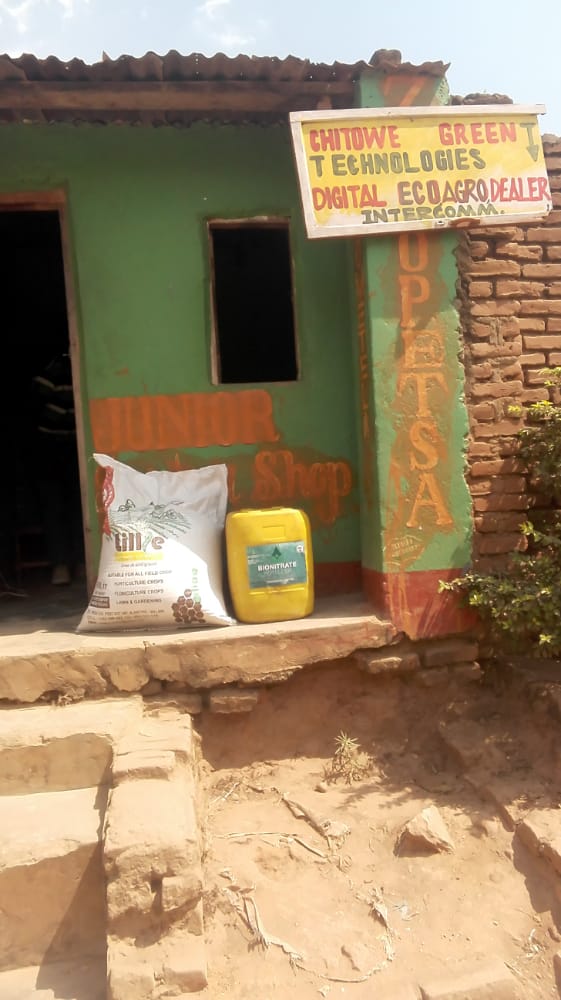
A young man by the name of Harold Chitowe, took this initiative as alternative to his unemployment situation, to put his idle time into productive use. He has been using his [poor condition] smartphone, acquired his own furniture and painted his own sign post to host the rural data collection platforms and cyberspace by providing internet, digital and data services to the rural community as Chitowe Green Technologies, a Digital eco-Agro-Dealer shop.
The DECODER was designed to follow the same data collection platforms and cyberspace model with some slight adjustments and eventually bring local volunteers on board, who subsequently form a radical CBO which takes over the community digital transformation.
In order to establish a successful Digital eco-Agro-Dealer shop, which offers options for low-cost farming inputs and access to knowledge/skills, it has to provide a value to many community members as much as possible.
Therefore, we had to assess the value of farming in the community and if it is limited by cost of inputs, knowledge and skills shortage and other agronomic factors. That is, “do they need shop?”.
This is basically the first part of the situation analysis, the problem verification – which is meant to confirm the pain point claimed by the local individuals aspiring to host the platforms and cyberspace. It attempts to answer the question “what is the particular community’s key social-economic problem(s), of which statistics and internet-based information would make sense to them and entice genuine interest and urgency to seek permanent solutions?”.
If the problem is misaligned, then the statistics and internet-based info might be useless to the community. In other words, digitalization of a rural community has to build upon its crucial social-economic matters distressing the majority so that interventions designed and delivered by the donors, NGOs, researchers and entrepreneurs are fully utilized rather than used as access to allowances or other immediate benefits only.
In this testing phase, we wanted to know if farming is offering an alternative to current economic crises and if the farmers are constrained by inputs cost following the rise in chemical fertilizer prices and devaluation of Malawian Kwacha currency, knowledge and skills gap and of course any other factors. We had to answer the following questions;
1. What does the community economically depend on?
2. Is the main economic activity or resources satisfying needs of the community?
3. If not, is farming offering an alternative to existing and uprising economic crises?
4. Is farming constrained with inputs cost, knowledge and skills gap, markets limitations, logistics, resources shortage, climatic or ecological and other related factors?
To answer these questions, a rapid appraisal, which involved random interviews with farmers and key informants and observations was conducted. See the results here.
 COMP@SS